
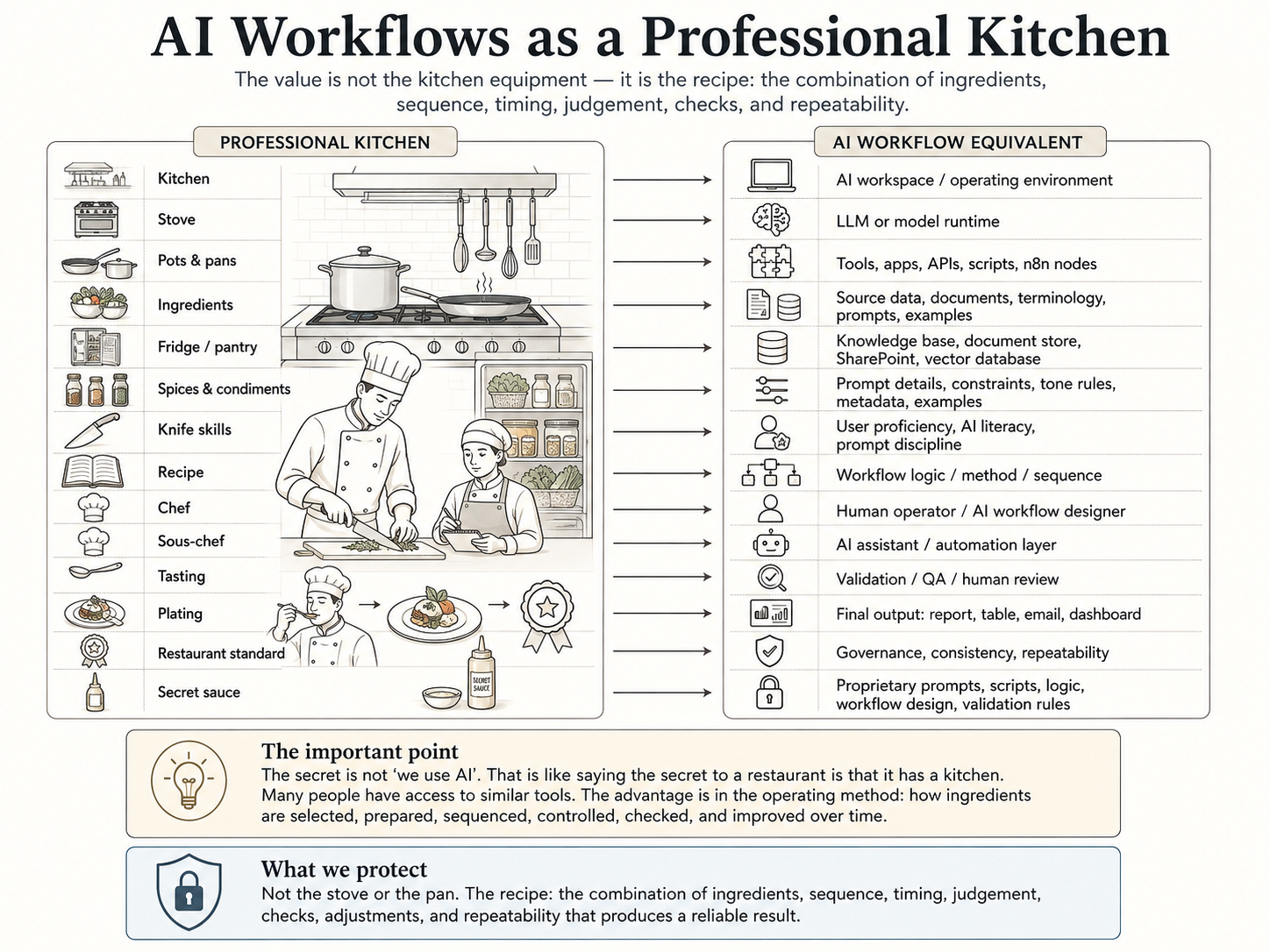
01
AI as a Kitchen
The tools matter, but the real value sits in the ingredients, sequence, judgement, checks and repeatability.
About
AI should fit around the work, not the other way around.
Augmented Work grew out of years spent working across complex knowledge, technology, operations and client environments — and more recently, building practical AI workflows and workspaces around that reality.
The work sits somewhere between technology, workflow design and the people doing the job.
How I Work
The starting point is rarely a model, agent or platform. It is the work itself: the information people rely on, the decisions they make, the friction they live with and the judgement that still matters.
Understand what people actually need to know, decide, check, remember and move forward.
The right model matters less if the surrounding knowledge, constraints and history are missing.
Useful systems become clearer when they are tested against real work rather than imagined use cases.
AI can support reasoning, but people still need to know what can be trusted, challenged or reviewed.
The AI Lab
The Lab is where I test how different parts of an AI-Augmented Work Environment behave in practice.
That might mean experimenting with retrieval, chunking, model behaviour, structured content, orchestration, evaluation, human review or a small workflow prototype.
The point is not to collect technology. It is to understand what actually helps the work.
Tools & Stack
I use different tools depending on the work, the constraints and the level of control required. The stack is modular by design.
Models, retrieval, orchestration and interfaces can change without changing the underlying way the environment is designed.
Ideas & Analogies
Some ideas begin as a sketch, a comparison or a way of making something complicated easier to explain.
They are not frameworks in themselves. They are ways of looking at the relationship between AI, knowledge, context and the work around them.
The tools matter, but the real value sits in the ingredients, sequence, judgement, checks and repeatability.
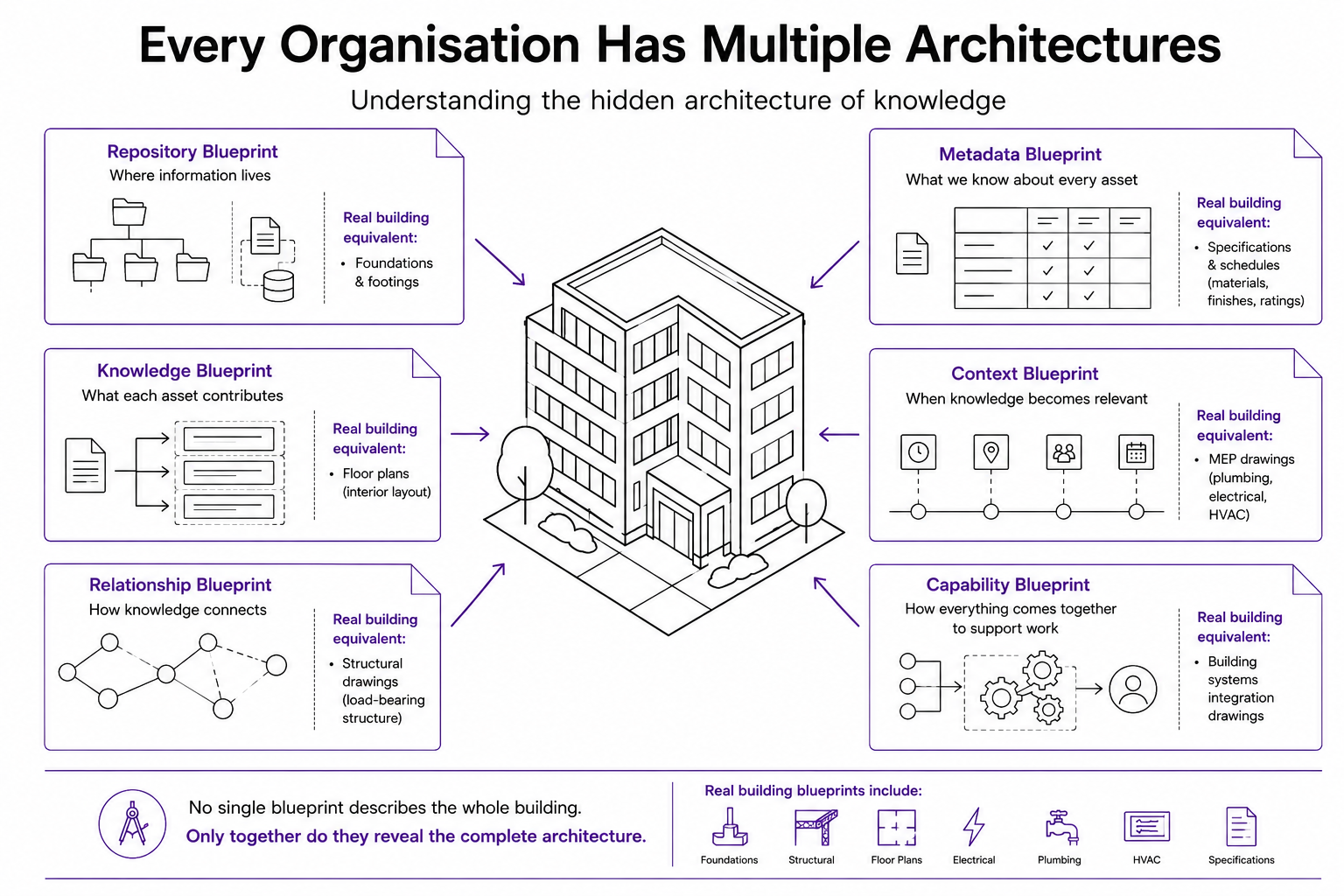
Repositories, metadata, context, relationships and capabilities each reveal a different part of the knowledge landscape.
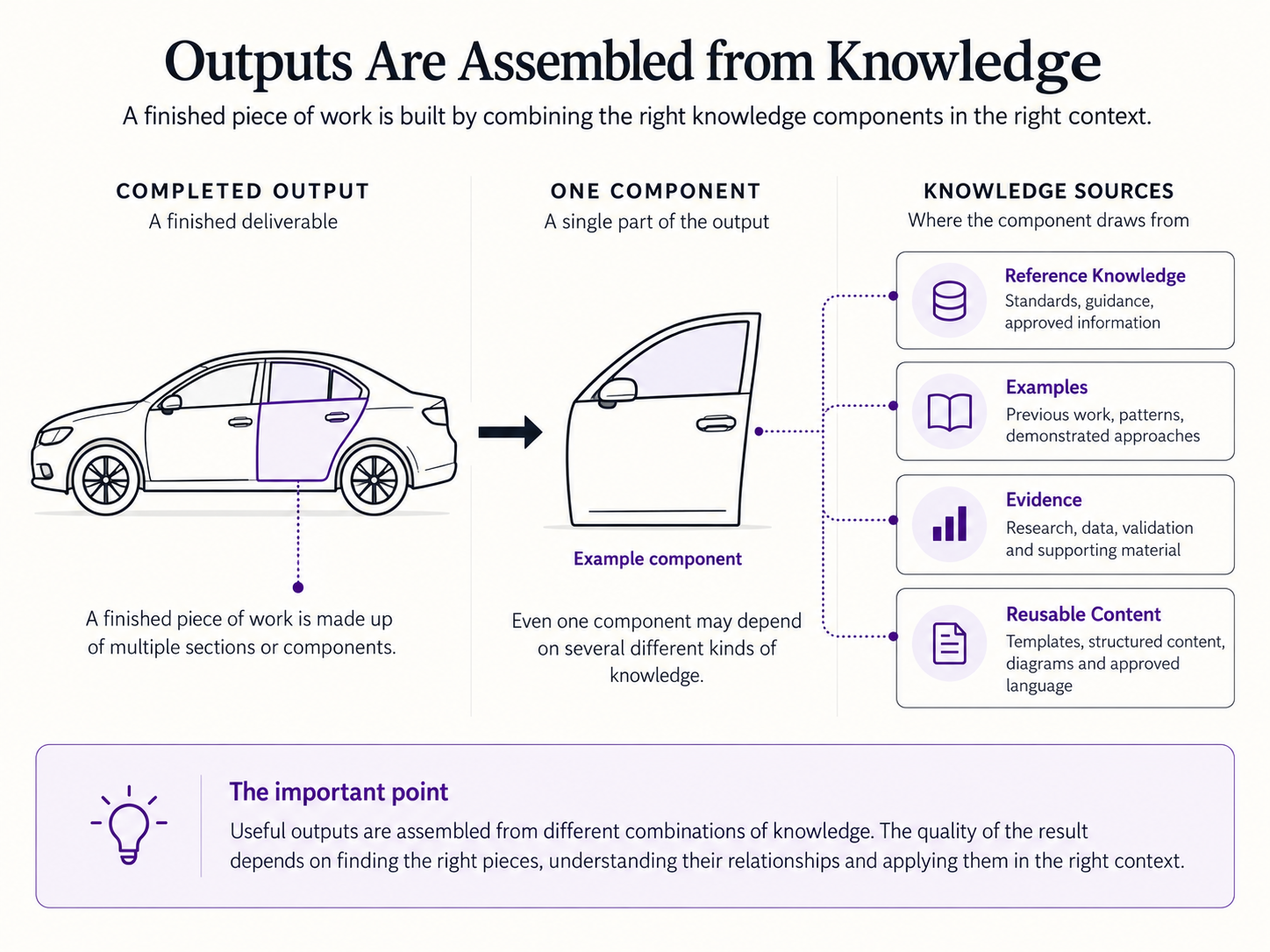
Useful outputs emerge by combining the right knowledge components and understanding their relationships, within the right context.
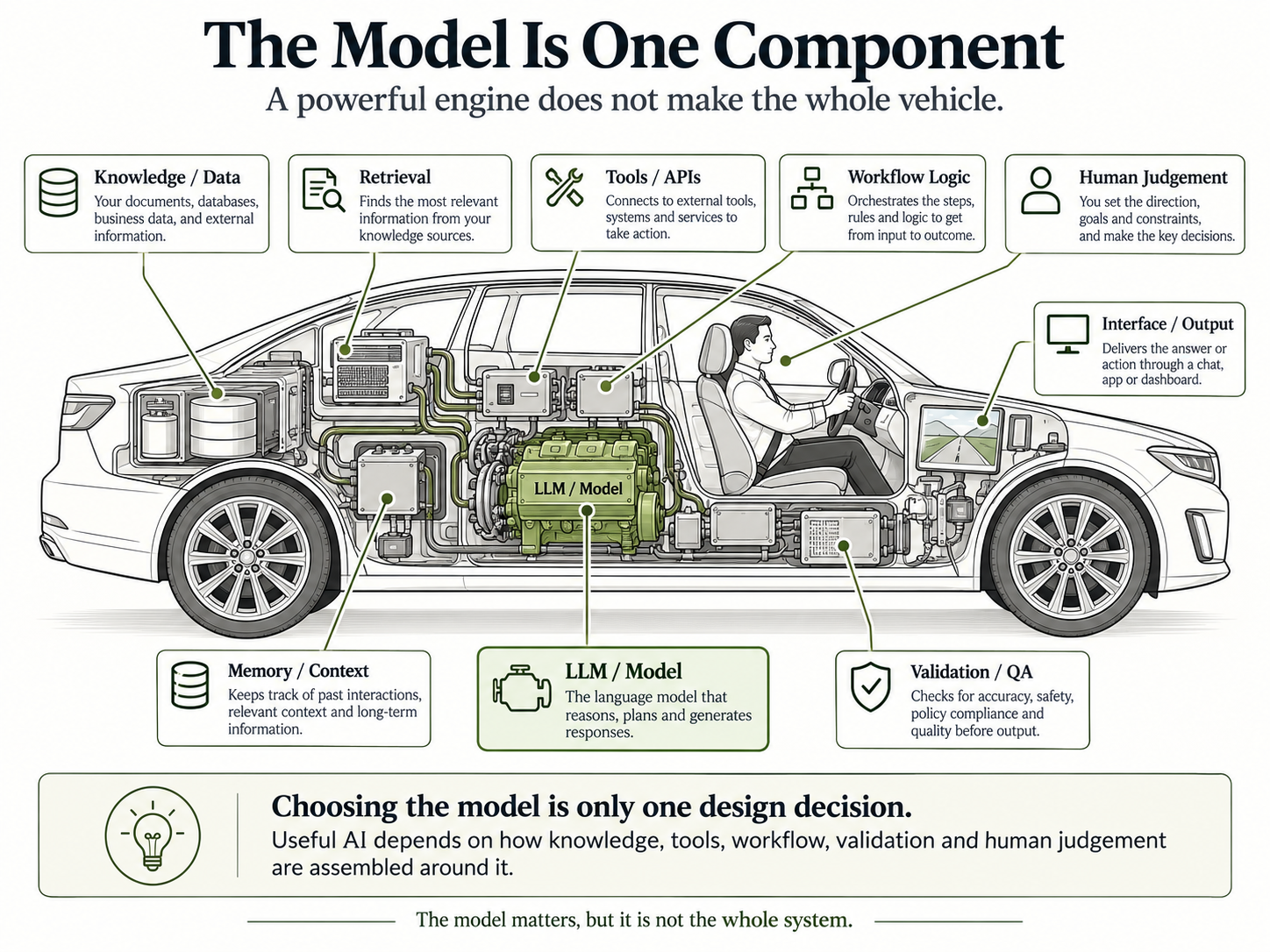
The model matters, but useful AI depends on the knowledge, retrieval, tools, workflow, validation and human judgement assembled around it.
Selected Experiments
The Lab is not about producing demonstrations for their own sake. Each experiment starts with a real problem and tests one small enough piece of it to learn something useful.
Problem
People repeatedly rebuild context from scattered documents, systems and past decisions.
Experiment
A small retrieval environment using representative sources and real working questions.
Learning
Retrieval quality depends as much on source structure, metadata and context as on the model itself.
Problem
Feedback and review signals accumulate, but recurring patterns are difficult to see consistently.
Experiment
A workflow that structures review data, surfaces repeated issues and supports human validation.
Learning
AI is most useful when it reduces repeated checking without hiding the evidence behind the judgement.
Problem
Content moves through repeated drafting, checking, rewriting and handoff stages.
Experiment
A multi-step pipeline combining structured input, generation, QA checks, validation and controlled rewrite.
Learning
The useful capability is not generation alone. It is the sequence, controls and feedback around it.
Problem
Important decisions require people to gather evidence, compare options and reconstruct assumptions.
Experiment
A workspace that brings evidence, risks, assumptions and prior context together around the decision.
Learning
AI can support reasoning without replacing accountability when evidence and human judgement remain visible.
The Point
It is to make difficult work easier to carry.